Loading depth chart…
 Sign inSign up free Sign inSign up free Sign inSign up free
Lake depth chart
Today's read
Rating depth structure for walleye.
Recent public catches load as you reach this section.
141-acre lake in Timiskaming District, Ontario. The lake tops out around 12 ft. The depth chart comes from Ontario Ministry of Natural Resources and Forestry bathymetric survey data, so the contours are survey-derived rather than computer-modeled. The depth data here comes from the Ontario MNRF survey of 1972, a decades-old survey (an MNRF lake survey). The rest of this page walks each species through its year, using the map's own scoring.
On the chart, Upper Twin Lake draws 140 acres inside 2.4 miles of shoreline. Its 1.4 shoreline index means few bank features; the contours below do the pattern work. Nothing on this chart breaks 15 ft, which makes the whole surface littoral: weeds, bait and ambush cover everywhere. Tip to tip the water measures near 0.9 mi with a 0.4-mi widest point. You'll find it in Timiskaming District. The nearest mapped water is Lillord Lake, 4 mi to the southwest.
Spring walleye on Upper Twin Lake hold shallow, usually 3 to 12 ft. Depth-wise the year is flat: 4 to 12 ft in summer, 4 to 12 ft once it turns cold. The chart's best answer is Break off the point — drop-off, 4 ft, prime for fall. Prime time lands in the evening and early morning. The summer box starts with a crawler harness on bottom bouncer or a deep crankbait (trolled).
Depth note: when a documented seasonal range extends below this chart, the table shows the deepest mapped working water, not a verified holding depth.
| Season | Depth | Best window | Start at | Go-to baits |
|---|---|---|---|---|
| Spring | 3 to 12 ft chart-limited; documented 4 to 15 ft | dusk & dawn | Break off the point (4 ft) | 1/8 oz jig + minnow, Hair jig |
| Summer | 4 to 12 ft chart-limited; documented 15 to 35 ft | dusk & dawn | Break off the point (4 ft) | Crawler harness on bottom bouncer, Deep crankbait (trolled) |
| Fall | 4 to 12 ft chart-limited; documented 12 to 40 ft | dusk & night | Break off the point (4 ft) | Jigging rap, Jig + big minnow |
| Winter | 4 to 12 ft chart-limited; documented 20 to 40 ft | dusk & dawn | Deep basin (10 ft) | Jigging spoon + minnow head, Rattle bait |
Early season yellow perch use the shallows, holding in 3 to 12 ft. Even in summer they hold at 4 to 12 ft; winter keeps them in 4 to 12 ft. The chart's best answer is Deep basin — deep basin, 10 ft, prime for fall. Best bite is early morning. Tie on a drop-shot micro plastics or a small spoon tipped with worm and you're in the game.
Depth note: when a documented seasonal range extends below this chart, the table shows the deepest mapped working water, not a verified holding depth.
| Season | Depth | Best window | Start at | Go-to baits |
|---|---|---|---|---|
| Spring | 3 to 12 ft | midday & dawn | Shallow bay flat (1 ft) | Small jig + curly tail, Perch-pattern micro crank |
| Summer | 4 to 12 ft chart-limited; documented 10 to 30 ft | dawn | Deep basin (10 ft) | Drop-shot micro plastics, Small spoon tipped with worm |
| Fall | 4 to 12 ft chart-limited; documented 12 to 35 ft | midday | Deep basin (10 ft) | Jigging spoon (small), Perch rig / spreader |
| Winter | 4 to 12 ft chart-limited; documented 15 to 35 ft | midday & dawn | Deep basin (10 ft) | Tungsten jig + spikes, Rattle spoon (small) |
In spring, northern pike run shallow here, mostly 2 to 8 ft. Midsummer fish sit out in 4 to 12 ft before dropping to 4 to 12 ft for winter. Fall northern pike concentrate at Break off the point, a prime-rated drop-off around 4 ft. Fish it in early morning and the evening and you'll meet the bite. You won't need more than a bucktail or a weedless spoon over cabbage most summer days.
Depth note: when a documented seasonal range extends below this chart, the table shows the deepest mapped working water, not a verified holding depth.
| Season | Depth | Best window | Start at | Go-to baits |
|---|---|---|---|---|
| Spring | 2 to 8 ft | midday & dawn | Shallow bay flat (1 ft) | #5 inline spinner, Spoon (red/white) |
| Summer | 4 to 12 ft chart-limited; documented 8 to 20 ft | dawn & dusk | Break off the point (4 ft) | Bucktail, Weedless spoon over cabbage |
| Fall | 4 to 12 ft chart-limited; documented 6 to 18 ft | midday & dawn | Break off the point (4 ft) | Big rubber (Bull Dawg style), Husky-style jerkbait |
| Winter | 4 to 12 ft chart-limited; documented 5 to 15 ft | midday | Shallow bay flat (1 ft) | Tip-ups, Large jigging spoon |
Come spring, look for lake whitefish tight to the bank in 4 to 12 ft. Through summer count on 4 to 12 ft; the winter hold is 4 to 12 ft. If you only fish one area, make it Deep basin: a deep basin around 10 ft that scores prime in summer. Best bite is early morning. A blade bait vertical or a small jigging spoon is the honest summer answer here.
Depth note: when a documented seasonal range extends below this chart, the table shows the deepest mapped working water, not a verified holding depth.
| Season | Depth | Best window | Start at | Go-to baits |
|---|---|---|---|---|
| Spring | 4 to 12 ft chart-limited; documented 15 to 45 ft | midday & dawn | Break off the point (4 ft) | Small jig + waxworm, Blade bait (small) |
| Summer | 4 to 12 ft chart-limited; documented 40 to 90 ft | dawn | Deep basin (10 ft) | Blade bait vertical, Small jigging spoon |
| Fall | 3 to 12 ft chart-limited; documented 8 to 30 ft | dusk | Break off the point (4 ft) | Small spoon (gold), Jig + plastic larva |
| Winter | 4 to 12 ft chart-limited; documented 25 to 70 ft | midday & dawn | Deep basin (10 ft) | Jigging spoon + bead chain, Tungsten jig + waxie |
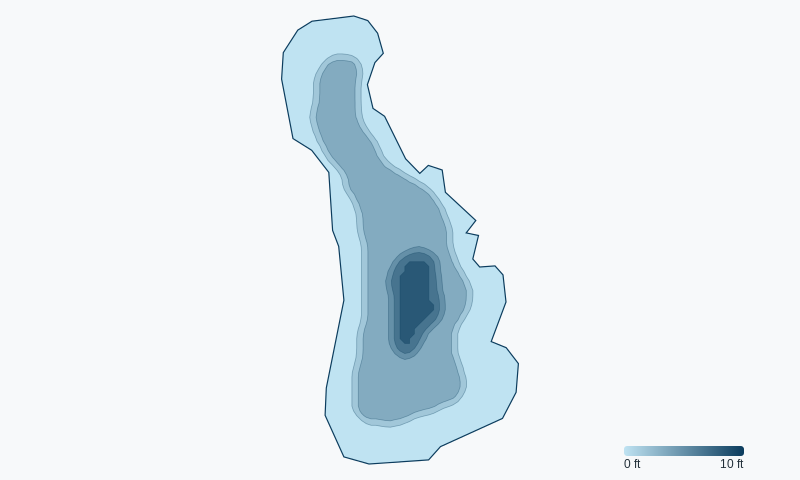
6 pieces of structure are mapped here — Deep basin, around 10 ft, is the deepest of them.
Season dates, license requirements, and size and bag limits for Ontario waters are set by the Ontario fishing regulations (FMZ summary) — and special regulations can apply to Upper Twin Lake specifically, so confirm the current rules before you fish.
Check the official Ontario fishing regulations →
Upper Twin Lake is about 12 ft (4 m) deep at its deepest point. The depth data here comes from the Ontario MNRF survey of 1972, a decades-old survey (an MNRF lake survey).
Anglers target walleye, yellow perch, northern pike, lake whitefish on Upper Twin Lake.
Break off the point is the top-rated area: a drop-off in about 4 ft of water that rates prime for walleye in fall. The map above holds the full rated-spot list for every species and season.
For walleye, the summer bite is best in the evening and early morning. Each species page section below lists the seasonal windows, and the map shows a live NOW badge when you're inside one.
Fishing on Upper Twin Lake is regulated by the Ontario fishing regulations (FMZ summary). Check the official Ontario regulations for current license requirements, season dates, and size and bag limits — special regulations can apply to this specific water.
Lillord Lake 4 mi · Sesekinika Lake 5 mi · Wewegimok L. 5 mi · Gale Lake 6 mi · Butler Lake 7 mi · Victor Lake 7 mi · Kenogami Lake 10 mi · Rathwell Lake 11 mi · Hancock Lake 12 mi · Perry Lake 12 mi · Lauramay Lake 12 mi · Nettie Lake 12 mi
See how Upper Twin Lake stacks up: best walleye lakes in Ontario · best northern pike lakes in Ontario · best yellow perch lakes in Ontario · best lake whitefish lakes in Ontario
More water nearby: Timiskaming District fishing maps (515 charts). Browse all Ontario fishing maps. See every water on DepthScout. Depth data: Ontario Ministry of Natural Resources and Forestry, Lake survey data (Open Government Licence – Ontario). How we build these maps. Fish here with a sonar unit that logs? Send us your depth data and we'll improve this chart, credited to you. For fishing guidance only, never navigation.