Loading depth chart…
 Sign inSign up free Sign inSign up free Sign inSign up free
Lake depth chart
Today's read
Rating depth structure for walleye.
Recent public catches load as you reach this section.
1,092-acre lake in Cochrane District, Ontario. The lake tops out around 50 ft. The depth chart comes from Ontario Ministry of Natural Resources and Forestry bathymetric survey data, so the contours are survey-derived rather than computer-modeled. Here is how the season plays out for each species, straight from the data behind the map.
On the chart, Takwata Lake draws 1,089 acres inside 19.3 miles of shoreline, broken up by 3 islands. A development index of 4.2 means a maze of bays and points: far more casting targets than a round bowl of the same size. About 97% of the surface sits shallower than 15 ft — that's the weed-and-bait zone. Call it 3.5 mi long by 2.1 mi wide at the broadest reach. You'll find it in Cochrane District. For a second option, Lake 19E-72 lies 16 mi east.
Come spring, look for walleye tight to the bank in 4 to 15 ft. Expect a summer slide to 15 to 35 ft, then a winter hold in 20 to 40 ft. Start at Deep basin. It's a deep basin holding about 24 ft of water and rates prime come winter. Prime time lands in the evening and early morning. A crawler harness on bottom bouncer or a deep crankbait (trolled) is the honest summer answer here.
| Season | Depth | Best window | Start at | Go-to baits |
|---|---|---|---|---|
| Spring | 4 to 15 ft | dusk & dawn | Secondary point (3 ft) | 1/8 oz jig + minnow, Hair jig |
| Summer | 15 to 35 ft | dusk & dawn | Deep basin (24 ft) | Crawler harness on bottom bouncer, Deep crankbait (trolled) |
| Fall | 12 to 40 ft | dusk & night | Deep basin (24 ft) | Jigging rap, Jig + big minnow |
| Winter | 20 to 40 ft | dusk & dawn | Deep basin (24 ft) | Jigging spoon + minnow head, Rattle bait |
Come spring, look for yellow perch tight to the bank in 3 to 12 ft. They move out to 10 to 30 ft in summer and finish the year down in 15 to 35 ft. If you only fish one area, make it Deep basin: a deep basin around 24 ft that scores prime in fall. Best bite is early morning. A drop-shot micro plastics or a small spoon tipped with worm is the honest summer answer here.
| Season | Depth | Best window | Start at | Go-to baits |
|---|---|---|---|---|
| Spring | 3 to 12 ft | midday & dawn | Shallow bay flat (1 ft) | Small jig + curly tail, Perch-pattern micro crank |
| Summer | 10 to 30 ft | dawn | Deep basin (24 ft) | Drop-shot micro plastics, Small spoon tipped with worm |
| Fall | 12 to 35 ft | midday | Deep basin (24 ft) | Jigging spoon (small), Perch rig / spreader |
| Winter | 15 to 35 ft | midday & dawn | Deep basin (24 ft) | Tungsten jig + spikes, Rattle spoon (small) |
Start shallow in spring: northern pike sit in 2 to 8 ft that time of year. Warm water sends them out to 8 to 20 ft; cold water stacks them in 5 to 15 ft. Top water on the chart: Shallow bay flat, a weed flat in the 1 ft range, good in spring. Fish it in early morning and the evening and you'll meet the bite. Throw a bucktail or a weedless spoon over cabbage until the fish tell you otherwise.
| Season | Depth | Best window | Start at | Go-to baits |
|---|---|---|---|---|
| Spring | 2 to 8 ft | midday & dawn | Shallow bay flat (1 ft) | #5 inline spinner, Spoon (red/white) |
| Summer | 8 to 20 ft | dawn & dusk | Shallow feeding flat (17 ft) | Bucktail, Weedless spoon over cabbage |
| Fall | 6 to 18 ft | midday & dawn | Shallow feeding flat (17 ft) | Big rubber (Bull Dawg style), Husky-style jerkbait |
| Winter | 5 to 15 ft | midday | Shallow feeding flat (17 ft) | Tip-ups, Large jigging spoon |
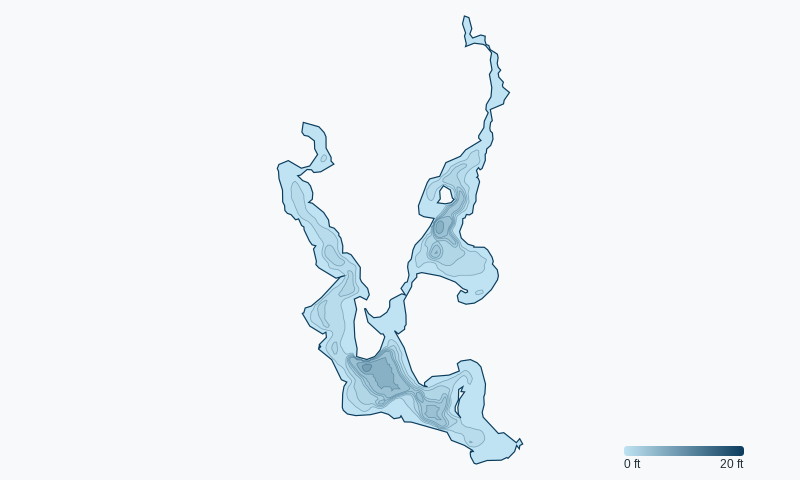
Takwata Lake carries 6 mapped structure features, topping out (or rather bottoming out) at Deep basin, about 24 ft down.
Season dates, license requirements, and size and bag limits for Ontario waters are set by the Ontario fishing regulations (FMZ summary) — and special regulations can apply to Takwata Lake specifically, so confirm the current rules before you fish.
Check the official Ontario fishing regulations →
Takwata Lake is about 50 ft (15 m) deep at its deepest point. The depth chart comes from Ontario Ministry of Natural Resources and Forestry bathymetric survey data, so the contours are survey-derived rather than computer-modeled.
Anglers target walleye, yellow perch, northern pike on Takwata Lake.
Deep basin is the top-rated area: a deep basin in about 24 ft of water that rates prime for walleye in winter. Scroll up to the map for the complete spot list by species and season.
For walleye, the summer bite is best in the evening and early morning. Each species page section below lists the seasonal windows, and the map shows a live NOW badge when you're inside one.
Fishing on Takwata Lake is regulated by the Ontario fishing regulations (FMZ summary). Check the official Ontario regulations for current license requirements, season dates, and size and bag limits — special regulations can apply to this specific water.
Lake 19E-72 16 mi · L. 19E-62 17 mi · Lake 17B-29 22 mi · 17C-19, L. 22 mi · Baker Lake 23 mi · Howells L. 92 23 mi · Howells L. 74 23 mi · Abimatinu Lake 23 mi · Fraserdale Lake 2 25 mi · Clay Lake 25 mi · Howells No. 19 26 mi · Nonigose Lake 26 mi
See how Takwata Lake stacks up: best walleye lakes in Ontario · best northern pike lakes in Ontario · best yellow perch lakes in Ontario
More water nearby: Cochrane District fishing maps (673 charts). Browse all Ontario fishing maps. See every water on DepthScout. Depth data: Ontario Ministry of Natural Resources and Forestry, Lake survey data (Open Government Licence – Ontario). How we build these maps. Fish here with a sonar unit that logs? Send us your depth data and we'll improve this chart, credited to you. For fishing guidance only, never navigation.