Loading depth chart…
 Sign inSign up free Sign inSign up free Sign inSign up free
Lake depth chart
Today's read
Rating depth structure for crappie.
Recent public catches load as you reach this section.
26-acre lake near Black Hawk County. The lake tops out around 18 ft. The depth chart comes from Iowa Department of Natural Resources bathymetric survey data, so the contours are survey-derived rather than computer-modeled. What the data behind the map says about each species, season by season:
On the chart, South Prairie Lake draws 26 acres inside 0.8 miles of shoreline. Nearly circular (index 1.1), so the story is the bottom, not the bank. About 95% of the surface sits shallower than 15 ft — that's the weed-and-bait zone. Call it 0.3 mi long by 0.2 mi wide at the broadest reach. You'll find it in Black Hawk County. The nearest mapped water is Green Belt Lake, 4 mi to the east.
Start shallow in spring: crappie sit in 2 to 8 ft that time of year. Warm water sends them out to 5 to 18 ft; cold water stacks them in 5 to 18 ft. Top water on the chart: Deep basin, a deep basin in the 18 ft range, prime in winter. Fish it in early morning and the evening and you'll meet the bite. Throw a jig trolled/spider-rigged or a small crankbait (trolled) until the fish tell you otherwise.
Depth note: when a documented seasonal range extends below this chart, the table shows the deepest mapped working water, not a verified holding depth.
| Season | Depth | Best window | Start at | Go-to baits |
|---|---|---|---|---|
| Spring | 2 to 8 ft | midday & dawn | Shallow bay flat (3 ft) | 1/16 oz jig + tube, Curly-tail grub |
| Summer | 5 to 18 ft chart-limited; documented 10 to 25 ft | dawn & dusk | Break off the point (13 ft) | Jig trolled/spider-rigged, Small crankbait (trolled) |
| Fall | 5 to 18 ft chart-limited; documented 8 to 20 ft | dawn | Break off the point (13 ft) | Jig + minnow combo, Small swimbait (1.5-2") |
| Winter | 5 to 18 ft chart-limited; documented 15 to 35 ft | midday | Deep basin (18 ft) | Tungsten jig + soft plastic, Tiny jigging spoon |
In spring, bluegill run shallow here, mostly 1 to 6 ft. Midsummer fish sit out in 4 to 15 ft before dropping to 5 to 18 ft for winter. Spring bluegill concentrate at Shallow bay flat, a prime-rated weed flat around 3 ft. Fish it in early morning and the evening and you'll meet the bite. You won't need more than a small sponge spider (fly) or a micro tube jig most summer days.
Depth note: when a documented seasonal range extends below this chart, the table shows the deepest mapped working water, not a verified holding depth.
| Season | Depth | Best window | Start at | Go-to baits |
|---|---|---|---|---|
| Spring | 1 to 6 ft | midday & dusk | Shallow bay flat (3 ft) | 1/32 oz jig + micro plastic, Tiny popper (evenings) |
| Summer | 4 to 15 ft | dawn & dusk | Shallow bay flat (3 ft) | Small sponge spider (fly), Micro tube jig |
| Fall | 6 to 18 ft | midday | Break off the point (13 ft) | Micro jig + waxworm, Small spoon tipped |
| Winter | 5 to 18 ft chart-limited; documented 10 to 25 ft | midday | Deep basin (18 ft) | Tungsten ice jig + plastic, Tiny spoon |
The spring pattern is a shallow one: largemouth bass in 2 to 10 ft. Midsummer fish sit out in 5 to 18 ft before dropping to 5 to 18 ft for winter. The spot to know is Shallow bay flat, a weed flat in about 3 ft of water that rates prime for largemouth bass in spring. Plan around early morning and the evening in the warm months. Summer baits: a texas-rigged 10" worm or a deep-diving crankbait gets it done.
Depth note: when a documented seasonal range extends below this chart, the table shows the deepest mapped working water, not a verified holding depth.
| Season | Depth | Best window | Start at | Go-to baits |
|---|---|---|---|---|
| Spring | 2 to 10 ft | dawn & dusk | Shallow bay flat (3 ft) | Spinnerbait, Chatterbait |
| Summer | 5 to 18 ft chart-limited; documented 8 to 20 ft | dawn & dusk | Break off the point (13 ft) | Texas-rigged 10" worm, Deep-diving crankbait |
| Fall | 4 to 15 ft | midday & dawn | Main-lake point (5 ft) | Squarebill crankbait (shad), Spinnerbait |
| Winter | 5 to 18 ft chart-limited; documented 15 to 35 ft | midday | Break off the point (13 ft) | Blade bait, Jigging spoon |
The spring pattern is a shallow one: channel catfish in 3 to 12 ft. Midsummer fish sit out in 5 to 18 ft before dropping to 5 to 18 ft for winter. The spot to know is Deep basin, a deep basin in about 18 ft of water that rates prime for channel catfish in winter. Plan around after dark and the evening in the warm months.
Depth note: when a documented seasonal range extends below this chart, the table shows the deepest mapped working water, not a verified holding depth.
| Season | Depth | Best window | Start at | Go-to baits |
|---|---|---|---|---|
| Spring | 3 to 12 ft | dusk | Shallow bay flat (3 ft) | |
| Summer | 5 to 18 ft chart-limited; documented 8 to 25 ft | night & dusk | Deep basin (18 ft) | |
| Fall | 5 to 18 ft chart-limited; documented 10 to 30 ft | dusk | Deep basin (18 ft) | |
| Winter | 5 to 18 ft chart-limited; documented 20 to 40 ft | midday | Deep basin (18 ft) |
Come spring, look for yellow perch tight to the bank in 3 to 12 ft. They move out to 5 to 18 ft in summer and finish the year down in 5 to 18 ft. If you only fish one area, make it Shallow bay flat: a weed flat around 3 ft that scores prime in spring. Best bite is early morning. A drop-shot micro plastics or a small spoon tipped with worm is the honest summer answer here.
Depth note: when a documented seasonal range extends below this chart, the table shows the deepest mapped working water, not a verified holding depth.
| Season | Depth | Best window | Start at | Go-to baits |
|---|---|---|---|---|
| Spring | 3 to 12 ft | midday & dawn | Shallow bay flat (3 ft) | Small jig + curly tail, Perch-pattern micro crank |
| Summer | 5 to 18 ft chart-limited; documented 10 to 30 ft | dawn | Deep basin (18 ft) | Drop-shot micro plastics, Small spoon tipped with worm |
| Fall | 5 to 18 ft chart-limited; documented 12 to 35 ft | midday | Deep basin (18 ft) | Jigging spoon (small), Perch rig / spreader |
| Winter | 5 to 18 ft chart-limited; documented 15 to 35 ft | midday & dawn | Deep basin (18 ft) | Tungsten jig + spikes, Rattle spoon (small) |
Come spring, look for walleye tight to the bank in 4 to 15 ft. Expect a summer slide to 5 to 18 ft, then a winter hold in 5 to 18 ft. Start at Break off the point. It's a drop-off holding about 13 ft of water and rates prime come fall. Prime time lands in the evening and early morning. A crawler harness on bottom bouncer or a deep crankbait (trolled) is the honest summer answer here.
Depth note: when a documented seasonal range extends below this chart, the table shows the deepest mapped working water, not a verified holding depth.
| Season | Depth | Best window | Start at | Go-to baits |
|---|---|---|---|---|
| Spring | 4 to 15 ft | dusk & dawn | Main-lake point (5 ft) | 1/8 oz jig + minnow, Hair jig |
| Summer | 5 to 18 ft chart-limited; documented 15 to 35 ft | dusk & dawn | Break off the point (13 ft) | Crawler harness on bottom bouncer, Deep crankbait (trolled) |
| Fall | 5 to 18 ft chart-limited; documented 12 to 40 ft | dusk & night | Break off the point (13 ft) | Jigging rap, Jig + big minnow |
| Winter | 5 to 18 ft chart-limited; documented 20 to 40 ft | dusk & dawn | Deep basin (18 ft) | Jigging spoon + minnow head, Rattle bait |
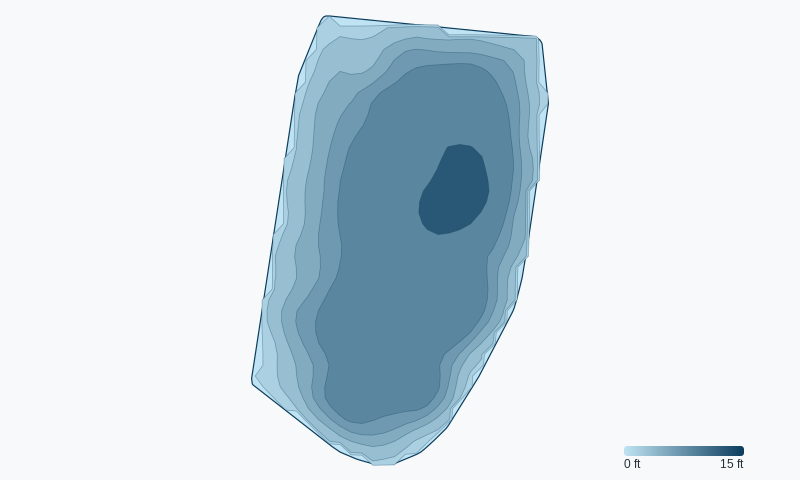
The chart marks 5 structure features on South Prairie Lake; the deepest is Deep basin at about 18 ft.
Season dates, license requirements, and size and bag limits for Iowa waters are set by the Iowa DNR — and special regulations can apply to South Prairie Lake specifically, so confirm the current rules before you fish.
Check the official Iowa fishing regulations →
South Prairie Lake is about 18 ft (5 m) deep at its deepest point. The depth chart comes from Iowa Department of Natural Resources bathymetric survey data, so the contours are survey-derived rather than computer-modeled.
Anglers target crappie, bluegill, largemouth bass, channel catfish, yellow perch, walleye on South Prairie Lake. This isn't a survey of the water — none is published for it — but an informed estimate from the species common to the region, narrowed by this water's depth, size and each species' range.
Deep basin is the top-rated area: a deep basin in about 18 ft of water that rates prime for crappie in winter. Scroll up to the map for the complete spot list by species and season.
For crappie, the summer bite is best in early morning and the evening. Each species page section below lists the seasonal windows, and the map shows a live NOW badge when you're inside one.
Fishing on South Prairie Lake is regulated by the Iowa DNR. Check the official Iowa regulations for current license requirements, season dates, and size and bag limits — special regulations can apply to this specific water.
Green Belt Lake 4 mi · George Wyth Lake 5 mi · Harold Getty Lake 8 mi · Meyers Lake 9 mi · Avenue of the Saints Pond 16 mi · Casey Lake (aka Hickory Hills Lake) 16 mi · Shell Rock River 25 mi · Cedar River 26 mi · Rodgers Park Lake 27 mi · Union Grove Lake 28 mi · Fontana Mill Lake 29 mi · Otter Creek Lake 30 mi
See how South Prairie Lake stacks up: best largemouth bass lakes in Iowa · best walleye lakes in Iowa · best crappie lakes in Iowa · best bluegill lakes in Iowa
More water nearby: Black Hawk County fishing maps (5 charts). Browse all Iowa fishing maps. See every water on DepthScout. Depth data: Iowa Department of Natural Resources, Lake bathymetry. How we build these maps. Fish here with a sonar unit that logs? Send us your depth data and we'll improve this chart, credited to you. For fishing guidance only, never navigation.